Faculty

UChicago President Alivisatos Joins the Humanities for an Immersive Experience
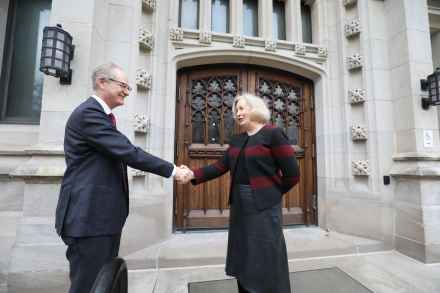
UChicago President Paul Alivisatos meets with the Division of the Humanities Dean Anne Walters Robertson to begin an Immersion Day in the Humanities.

New UChicago President Paul Alivisatos spent Dec. 3, 2021, focused on understanding what the Division of the Humanities does by listening to multiple academic leaders, faculty members, and undergraduate and graduate students discuss its strengths, concerns, and future.

“We were delighted that the President was able to meet so many faculty, students, and staff, and could hear about the rich and varied work in scholarship, creation, and teaching that we carry out continually in the Division,” said Anne Walters Robertson, Dean of the Division of the Humanities and the Claire Dux Swift Distinguished Service Professor in the Department of Music and the College.

Like the leaders at the UChicago Humanities Division, Alivisatos worries about the shrinking number of jobs in academia and having the right number of students in the Division’s master’s programs. However, he found reassurance throughout his Immersion Day, in such recent forward-looking undertakings as graduate students' research projects,  the Media Arts, Data, and Design Center, master’s program for Digital Studies, and strong collaborations of the Division with other parts of UChicago. Alivisatos was also impressed with the Division's recent creativity in institution building.

While the number of humanities majors and courses have plummeted at many universities, the Division of the Humanities at the University of Chicago has shown significant growth in enrollments from 2010 to 2019. Rigorous teaching, innovative programs, and interdisciplinary studies continue to attract undergraduate and graduate students to UChicago Humanities.

Alivisatos’s day began at the Walker Arts Museum for a breakfast and discussion with Robertson, wound through meetings in Foster, Stuart Hall, Classics, Crerar Library at the Weston Game Lab, and ended at a dinner in Logan Performance Center Penthouse with 23 Humanities Division faculty and four Humanities Council members.
ECHO Game Brings Students Together--and Keeps Them Safe

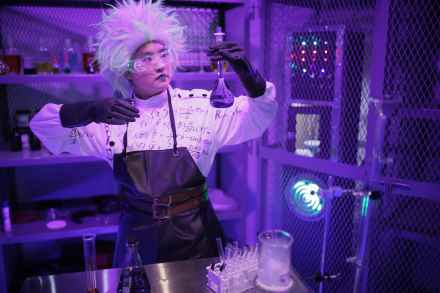
Culminating in an Oct. 30 livestream, ECHO brought together students and other members of the UChicago community through weeks of collaborative play. Photo courtesy of the Fourcast Lab

A portal in the Regenstein Library. A rabbit hole to a mysterious alternate universe. Messages from the beyond—and the 1980s. This might seem like an alternate plot of Back to the Future, but you won’t find Marty McFly combing the library stacks. All of these elements were part of ECHO, the newest game launched by the University of Chicago’s Fourcast Lab.

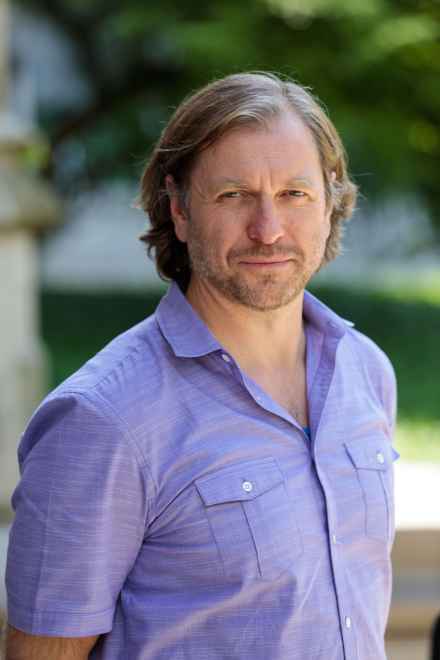
“Purely educational games tend not to work well,” said Fourcast Lab member Patrick Jagoda, a professor of English Language and Literature and Cinema & Media Studies and director of the Weston Game Lab. “Instead, we wanted to embed safe and healthy behaviors within more engaging or creative quests.”

Robert Bird, prolific scholar of Russian literature and film, 1969–2020

Robert Bird

Prof. Robert James Douglas Bird—an expert on Russian literature, film and modernism—died Sept. 7 in Chicago after a nine-month battle with colon cancer. He was 50.

“Robert’s outstanding biographical and critical work made a lasting impression on the fields of Russian literature, cinema and intellectual history,” said Anne Walters Robertson, dean of the Division of the Humanities and the Claire Dux Swift Distinguished Service Professor of Music. “As a legendary teacher and mentor, he also will be sorely missed.”

Court Theatre Reimagines the Stage Through Online Programs During Pandemic

Sarah Nooter

For Court Theatre executive director Angel Ysaguirre, the magic of the stage exists in the actors’ ability to connect with the audience—to see their smiles and their tears, and to hear their laughter, gasps and applause.

But the coronavirus pandemic has forced all large gathering spaces to close, putting “the electricity of theater,” as Ysaguirre puts it, on hold for the indefinite future. Instead of shutting its doors completely for the upcoming academic year, Court will transition to an all-digital platform, allowing audiences to reinterpret productions from their own computers.

In October, for example, Prof. Sarah Nooter will use Euripedes’ The Bacchae—based on the Greek myth of King Pentheus and his punishment by the god Dionysus—as a way to explore the contemporary manifestations of intertwining the personal and political, and the importance of listening to the will of the people. 

Pages