Faculty

Patrick Jagoda Discusses Time Travel, Video Games During Interdisciplinary Panel
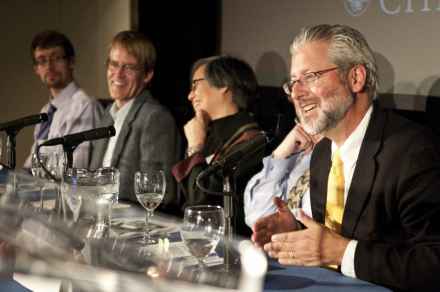
On November 7 at the Field Museum, a multidisciplinary panel composed of University of Chicago faculty together with Argonne National Laboratory and Fermi National Accelerator Laboratory researchers and engineers convened to discuss the topic of time. “Playing with Time” was the sixth in a Joint Speaker Event series organized by the Office of the Vice President for Research and for National Laboratories. Questions discussed by the panel included, “Did humans invent time to help explain everything around us? Was there time before the origin of the universe?” and “How does a virus experience time?”

Patrick Jagoda, Assistant Professor of English, noted the ways humanities fields like literature and new media grapple with the notion of time, such as in the novel Einstein’s Dreams. “Clock time makes ordered schedules possible, but bodily time is shaped by moods, desires and whims,” he said. “Another scheme imagines time as a current of water occasionally displaced by passing breezes.” Video games, he noted, have developed ways to allow users to manipulate time.

The question of time travel fascinated the panel. Joseph Lykken, a particle theorist at Fermilab, explained that travel to the future has been observed with particle accelerators. “Muons (subatomic particles), for example, usually survive for a microsecond, but when we speed them up they can survive a thousand times as long. They have traveled to the future.” For the humanities, time travel may involve fewer subatomic particles and more creativity. Jagoda noted that reading an old book or playing a video game can be an imaginative way to put oneself in another time.

'Invisible Man' Adaptation among Honors for Court Theatre

Court Theatre won three awards at the 44th annual Equity Jeff Awards ceremony on October 15. From the theatre's fifteen nominationsInvisible Man (in association with Christopher McElroen Productions) earned the New Adaption (Play) award, Larry Yando won the award for Actor in a Principal Role (Play) for his portrayal of Roy Cohn in Angels in America, and Timothy Edward Kane received the Solo Performance honor for his work in An Illiad. Ken Warren, the Fairfax M. Cone Distinguished Service Professor in English, served as adviser to this first-ever stage production of Invisible Man.

From the article:

"I’m also thrilled that Court’s world-premiere adaptation of Ralph Ellison’s Invisible Man, adapted by Oren Jacoby, was awarded a Jeff for Best New Adaptation. A product of close collaboration between Court Theatre’s artists and University scholars like Ken Warren, Invisible Man’s continuing success in Chicago and beyond is a testament to what Court and the University of Chicago can achieve in partnership," Newell added.

Read the full article here.

Three Faculty Members Recognized With Named Professorships

Thirteen University of Chicago faculty members were recognized for their outstanding service with named professorships, including three from the Division of the Humanities.

  • Frances Ferguson was named the Ann L. and Lawrence B. Buttenwieser Professor in English Language and Literature and the College. Her research interests include 18th- and 19th-century literature, as well as 20th- and 21st-century literary theory. Ferguson, who comes to the University from Johns Hopkins University, is currently at work on a project that explores the rise of mass education and how it affects our conception of both individuals and society.
  • David J. Levin has been appointed the Addie Clark Harding Professor in Germanic Studies, Cinema and Media Studies, Theater and Performance Studies, and the College. His latest book, Unsettling Opera: Staging Mozart, Verdi, Wagner and Zemlinksy, (University of Chicago Press, 2007), explores how radical stagings impact one’s understanding of classic operas. Levin, an expert on German opera, theater, cinema and performance theory, serves as executive editor of Opera Quarterly and as the director of the Richard and Mary L. Gray Center for Arts and Inquiry.
  • Eric Santner, was named the Philip and Ida Romberg Distinguished Service Professor in Germanic Studies and the College. Santner is a leading scholar of German literature, history and culture, and works at the intersection of literature, political theory, philosophy, psychoanalysis and religious thought. His most recent book, The Royal Remains: The People’s Two Bodies and the Endgames of Sovereignty, was published by the University of Chicago Press in 2011.

Read faculty biographies and learn about all of the named professorships here.

Pages