Arts & Humanities Day 2025 sparks citywide conversation
By Rivky Mondal, Andrew Haffner
Dec 2, 2025
by David T Kindler/Chicago Humanities Festival
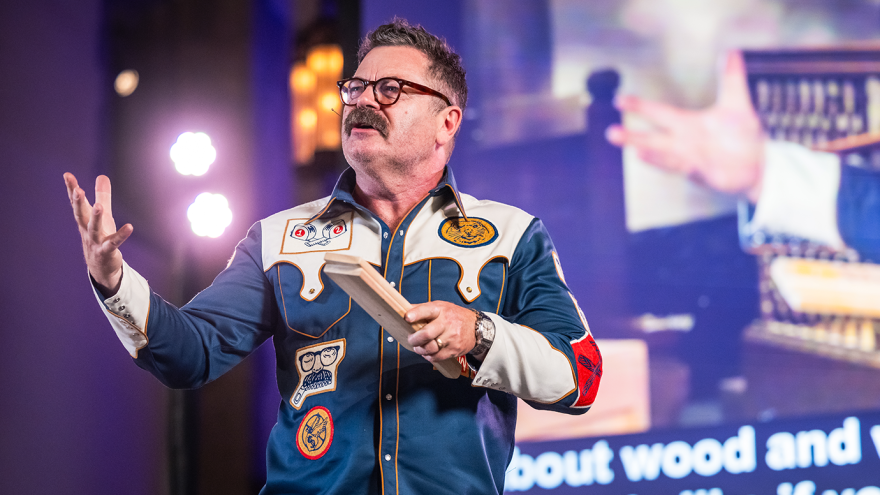
On a recent day in Hyde Park, fans of Taylor Swift gathered in their Eras Tour T-shirts to hear a scholarly breakdown of the singer’s lyrics. Authors Roxane Gay and Stephen Dubner reflected on the legacy of their culturally defining books (Bad Feminist and Freakonomics, respectively). While strumming on his guitar, actor Nick Offerman accompanied a woodworking demonstration for a packed Rockefeller Chapel.
On Oct. 18, the University of Chicago welcomed more than 4,000 attendees for Arts & Humanities Day, its annual celebration of art, literature, music and ideas.
In a new partnership with Chicago Humanities, the daylong celebration brought scholars, students, artists, and neighbors into dialogue across more than two dozen sessions—dynamic, standing-room-only discussions hosted across campus.
Arts & Humanities Day 2025 showcased a broad range of UChicago faculty, who shared highlights from their scholarship and engaged in dialog with visiting artists and scholars. Throughout the day, participants returned to a central theme: how the arts and humanities help us understand who we are, where we come from and what we choose to value.
“It was a joy to host this new and expanded version of Arts & Humanities Day in partnership with Chicago Humanities,” said Deborah L. Nelson, dean of the Arts & Humanities. “Research and teaching in humanistic disciplines is woven deeply into the fabric of the University of Chicago. And it’s truly thrilling to host occasions where academic expertise in these fields can be in dialogue with audiences beyond our campus community—to collectively celebrate and rigorously explore the writing and art and scholarship that provide deeply meaningful sources of beauty and wisdom to so many.”
In the following snapshots, take in the sights of sounds of Humanities Day, which included topics ranging from South Side home movies to Bob Dylan’s harmonica.
Swifties in Socratic debate: Stephanie Burt and Paula Harper on Taylor Swift
An electric energy built in the crowd during a wide-ranging conversation between UChicago musicologist Paula Harper and literary scholar Stephanie Burt—two researchers embedded in the fan discourse of Taylor Swift from their respective fields.
Burt, a professor of English at Harvard University, approached Swift through the lens of cultural theory, gender politics and poetic form; Harper, whose work takes pop culture seriously as cultural machinery, examined Swift’s musicology, production choices and sonic identity.
Together, for an audience of Swift fans spanning students, neighborhood regulars, parents and alumni, they modeled how rigorous humanities research can sharpen our appreciation of a cultural phenomenon that is so ubiquitous that we start to lose sight of it.
If any one session could be said to capture the ethos of Arts & Humanities Day, it was theirs: deeply scholarly, joyfully accessible and profoundly intergenerational.
Sustaining cultural stewardship: Oak Woods Cemetery and the South Side Home Movie Project
In the session, “Studying Oak Woods,” UChicago faculty members Adam Green, Na’ama Rokem and Emily Crews introduced audiences to histories embedded in the historic Oak Woods Cemetery located in Chicago’s Greater Grand Crossing neighborhood.
Since 1853, the cemetery has served as the final resting ground for many prominent Black Americans, including Chicago Mayor Harold Washington, educator and activist Ida B. Wells and Olympian Jesse Owens.
The panel provided a humanistic perspective on site-specific community engagement on the South Side, highlighting courses that engaged with the personal and cultural histories of the cemetery.
For example, in postdoctoral fellow Pranathi Diwakar’s course, “Social Life and Death in the City,” undergraduate and graduate students produced audio essays about Oak Woods Cemetery that were broadcast on Chicago-based Lumpen Radio.
The scholars’ work underscored a broader theme: students as cultural stewards. As Green noted, in an era shaped by AI, the ability to gather information firsthand and share it meaningfully with communities is a foundational humanistic skill—and one students are eager to practice.
The session dovetailed with another featuring UChicago Prof. Jacqueline Stewart, founder of the South Side Home Movie Project. Stewart traced the project’s origins from placing small ads in Hyde Park newspapers to building one of the most significant archives of South Side homespun, “amateur” films spanning 1929 to 1986.
These reels—birthday parties, holiday mornings, picnics—capture a rich history of everyday Black life.
During the Q&A, Stewart and audience members struck up a conversation on the future of preservation. The dialogue illustrated the project’s central philosophy: honoring what donors value in their films rather than imposing institutional expectations.
The result, Stewart noted, is not only a cultural archive but a real form of capital for communities that affirms the beauty, creativity and lineage held within Chicago’s multi-ethnic South Side.
Listening for charisma: Steven Rings on Bob Dylan’s harmonica
In a session that was equal parts scholarly and sonically immersive, UChicago musicologist and Prof. Steven Rings explored what he called Bob Dylan’s “non-verbal eloquence.”
“The harmonica is the only instrument that stops the flow of Dylan’s words,” Rings explained to a group split between Dylan aficionados and music scholars. “It occupies the channel of the voice—on the same breath—and noisily blocks language.”
For a moment, Rings explained, Dylan is “deprived of words” by the instrument, creating “breathing room” inside his famously dense lyrics.
Rings also traced Dylan’s foundational inspirations, from Black blues traditions to modernist borrowings from Rimbaud to the proto-punk sensibility that shaped his early mythos.
Tools and tomfoolery: Nick Offerman and Leslie Buxbaum on the lessons of woodworking
When UChicago Assoc. Prof. Leslie Buxbaum sat with actor Nick Offerman in front of a sold-out crowd at Rockefeller Chapel, she had to ask: How is wood a teacher?
It was an apt prompt for Offerman, best known for his role as gruff civil servant Ron Swanson on the series Parks and Recreation. Offerman is also a seasoned commercial woodworker whose Los Angeles-based shop makes custom furniture and other crafts.
The session began with a woodworking demonstration, in which woodshop manager Lee Buchanan handled the tools, explaining her process as she built a plywood slapstick. Offerman led the tomfoolery—riffing for the crowd, serenading them with songs played on handmade instruments and finally taking a smack from Buchanan’s handiwork.
After the demonstration, Offerman and Buchanan sat for a conversation with Buxbaum, in which the actor shared some of the personal philosophy that ties together the seemingly disparate parts of his career.
“We love making things beautiful, but the point of it, all of it, is the attempt at perfection,” Offerman said. “To me, it was a wonderful lesson to learn that it will always be flawed, but your attempt gets left behind. I like to say that mastery in woodworking is just being able to hide your mistakes better.”
Embracing that imperfection—whether in wood or in himself—has driven his best work, both on screen and in the shop, he said.
“I thought I had to be way cooler than I was, so when I auditioned, I would try way too hard and fail—so then I had a lot of free time to build scenery,” he said, describing his early years as an actor. “But I learned that, whatever this flawed donkey package is, there are roles for that guy.”
The actor came to Hyde Park with Buchanan to promote their new book, Little Woodchucks: Offerman Woodshop’s Guide to Tools and Tomfoolery. Written for children and families, the book lays out crafting projects with the offbeat, folksy humor that is Offerman’s trademark.
“I love giving thoughtful gifts of something like this book,” Offerman said. “The more laughs it gets, the more I'm probably trying to say I love you.”
Planning for Arts & Humanities Day 2026 i already underway.
Originally posted on UChicago News.